


hamlet, fraction
of Sinibalda Rock


the story of posticciola

historical notes
Posticciola is a charming medieval village in Sabina, located at 572 meters above sea level, overlooking Lake Turano. Thanks to its strategic location along ancient transhumance routes, for centuries it was an important stopping point for shepherds and travelers heading towards the Roman countryside.
Its origins are intertwined with the Roman and medieval history of the area, as evidenced by the archaeological remains and the characteristic urban layout, still perfectly preserved.
Strolling through the alleys, arches, and panoramic views, you sense the authenticity of a place that preserves traditions, legends, and evidence of over a thousand years of history.

the Romanesque bridge
Situated on the Turano River at the foot of the village, the Romanesque Bridge is one of Posticciola's most iconic landmarks. Originally built in Roman times and rebuilt in the 12th century, it is a magnificent example of historical engineering that for centuries connected the two banks of the valley.
Herds, merchants, pilgrims, and travelers passed along the bridge during the transhumance, making it a vital hub for the local economy.
Surrounded by popular stories and traditions, today it constitutes an evocative stop for hikers and walkers who travel the historic paths of the area and the great spiritual paths of the territory.

the church of the immaculate conception
In the historic center of Posticciola stands the Church of the Immaculate Conception, a religious building of medieval origin, probably built on the ruins of an older place of worship.
The simple yet charming interior houses important works of art, including restored paintings dedicated to the Immaculate Conception, Our Lady of the Rosary, and Saint Barbara. Also of particular note are the historic wooden furnishings and the precious inlaid piece of furniture from the late 16th century.
For centuries, the church has been the focal point of the town's religious and community life, hosting celebrations, processions, and traditions passed down from generation to generation.

the museum of peasant and artisan traditions
The Museum of Peasant and Artisan Traditions and the characteristic Diffused Museum tell the daily story of Posticciola's inhabitants through work tools, household objects, and reconstructions of traditional environments.
The installations, distributed along the village streets and within dedicated exhibition spaces, allow visitors to rediscover the crafts, customs, and moments of rural life that have characterized the area for centuries.
The museum tour offers an authentic and engaging experience, enhancing the community's collective memory and keeping the cultural roots of the Turano Valley alive.
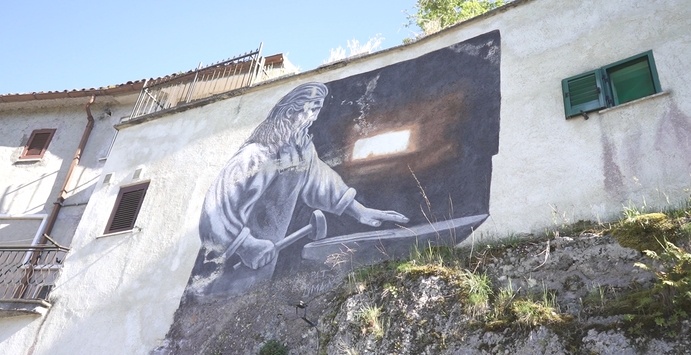
the 15 murals of the village
The streets of the village are enriched by a series of murals created by the artist Manuela Merlo, aka UMAN, which transform the facades of the houses into a true open-air art gallery.
The works depict scenes of peasant life, artisanal activities, and popular traditions that have marked the history of the local community.
Each mural contributes to a fragment of the past, creating an artistic journey that leads the visitor through culture, memory, and identity. Art thus becomes a tool for preserving and passing on the country's historical heritage.

the fortress mareri flacchi solivetti
Overlooking the Turano Valley from above, the Rocca Mareri Flacchi Solivetti represents one of the most important historical testimonies of Posticciola.
Built as a defensive structure between the early Middle Ages and the Lombard era, it controlled the passage along the ancient trade routes and the borders between different territories.
Over the centuries it belonged to important noble families and was expanded and transformed while maintaining its original military character.
Today, thanks to careful restoration, the fortress has regained its splendor and continues to tell the story of a strategic territory, offering an extraordinary testimony to the fortified architecture of Sabina.
the lake and the Turano dam
At 536 m above sea level, Lake Turano is a large hydroelectric basin created on the river of the same name with the construction of the Turano dam in 1939, near the villages of Posticciola and Stipes.
About ten kilometers long and with a perimeter of approximately 36 km, it is connected to Lake Salto by a 9 km long tunnel. Together, it feeds the Cotilia hydroelectric plant, part of E.ON's Terni Hydroelectric Power Plant. The waters then flow into the Velino River, upstream of both the city of Rieti and the confluence of the Salto and Turano rivers. These rivers flow into the Velino River in their natural course, the Salto just before the town of Rieti and the Turano downstream of Rieti in the Rieti Plain.
THE NATURE TRAILS

This historical-landscape path winds from the lower part of Posticciola until it reaches, through a short and easy path through the woods, the “garitta muraria” (A), a small military outpost on the border between the Papal State and the Kingdom of the Two Sicilies, where it was obligatory to pay a toll for the passage of flocks (transhumance) destined for the fertile pastures of the Agro Romano.
Adjacent to the “sentry box” we find the imposing structure of the “Romanesque Bridge” (B) known as the “Old Bridge”, dating back to the 11th century but probably built on a pre-existing structure of an unspecified age, of rare beauty, which crosses the Turano river and is located a few hundred metres before the Posticciola dam.
Beatrice Cenci, a fugitive, passed over this bridge and took refuge in Petrella Salto to escape family persecution (a futile escape as she was tracked down and executed on 11 September 1599 in the Piazza di Ponte Sant'Angelo in Rome).
After crossing the bridge, you can continue along the path of San Benedetto on the right, while on the left the trail leads to a charming "footbridge over the Turano River" (C) adjacent to the remains of an old millstone. After crossing the river, the trail leads back, via a circular route, to the village of Posticciola. Trail length: approximately 1.85 km; travel time: approximately 50 minutes.